Feeds:
Posts
Comments

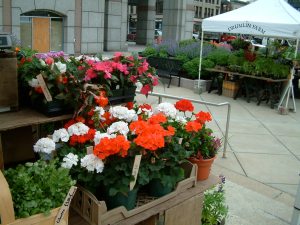
There is a new farmer’s market in Boston outside the Prudential mall that is just a few blocks away from my cubicle . I went there last week with a couple of colleagues.

Geraniums at the farmers' market

There is nothing quite like being able to push back from the computer to take a stroll in the brisk spring air. Smelling potted basil and haggling for a half a bunch of asparagus pulled the focus off the deadlines waiting back at my desk.

Continue Reading »

Michelle Obama & Elmo

Elmo and Michelle Obama made quick friends on Sesame Street recently to give a public service announcement for parents: Eat right and exercise and your kids will, too.

This is a far, far cry from the habits that Cookie Monster used to teach us when I was watching Sesame Street religiously in the early 1970s. (Think “C is for Cookie.”) So much for early education. I suppose we also should have been wearing helmets when we rode our Big Wheels.

Continue Reading »

This has been some week of  deep thinking about food.

First, I went to Boston University’s free conference on the Future of Food.

There were a lot of wonderful thinkers there for the morning sessions that I attended. But the thing that has stuck with me the most was a comment that had nothing to do with food. Satish Kumar, a former Jain monk, shared some wisdom he learned from begging (this is how monks subsist). He said that if someone gave him food, he was grateful. If someone didn’t give him food, he was also grateful – because it was an opportunity to fast.

Wow. Chew on that for a few minutes. I can’t count the number of times I’ve been irked by not getting what I want when I want it. I’ll try practicing gratitude next time and see what happens.

Continue Reading »

Food memoirs are rapidly filling bookstore shelves these days, and just when you would think that there is simply nothing new to add to the topic along comes an original voice like Molly Wizenberg and her book A Homemade Life: Stories and Recipes from My Kitchen Table.

Read the full review here.

Mark Bittman, food columnist for The New York Times, has joined the Greek chorus of foodies for a better planet. Openly acknowledging that he is building on the investigative work of Michael Pollan (“The Omnivore’s Dilemma”) and others, Bittman has taken up the mantra of: eat more plants, fewer animals, and less in general.

Although Bittman’s new book, Food Matters, largely repeats well-documented food research, he does bring something new to the table: recipes and a four-week meal plan.

Read the full review here and a post about meeting Mark Bittman here.

No one can deny the power of a steaming, full plate to transport one to some other time or place. And yet food, or a meal, can also play a minor character in an intense drama.

Everyone has an expert opinion about food these days but it takes a good writer to decipher the emotions that surround the daily act of eating. Eat, Memory is a collection of 26 essays by noted authors who do just that.

The essays first appeared in The New York Times Magazine under its “Eat, Memory” column after being skillfully edited by Amanda Hesser, a former food editor there and a delightful writer herself.

To read a full review and listen to an interview with Amanda Hesser, click here.

If your family enjoys a home-cooked “Italian night” at least once a week, you can probably thank Marcella Hazan. And if you are going to thank Hazan, be sure to thank her husband, too.

Hazan, considered by some as one of the most influential Italian cooks in the United States and Britain, has made certain, through six classic cookbooks and nearly four decades of classes, that her followers understand the taste of Italian cooking beyond spaghetti and meatballs.

And now Hazan has selected the best stories from her own life to present Amarcord: Marcella Remembers with all the warmth and humor of a long meal in famiglia made from the choicest ingredients.

To read a full review and listen to an interview with the author, click here.

Sarah Beth Glicksteen/The Christian Science Monitor

Sarah Beth Glicksteen/The Christian Science Monitor

When it comes to vegetables, even urban “locavores” can get their hands dirty in the effort to eat only local foods. All you need is a bit of sun and a patch of soil, and by summer’s end you can decorate salads with your own “locally grown” produce.

Meat, on the other hand, is another challenge completely. That’s best left to farmers and ranchers.

Local meat – livestock consumed within 150 miles of the place where it was humanely raised – is still a relatively small industry. However, more farmers’ markets, mail-order companies, and stores that specialize in organic or local foods are featuring local meats. (To find a store near you, visit www.localharvest.org.) Proponents are quick to point to the benefits: Local meats aren’t exposed to the same stresses commonly found in feedlots, and there is a noticeable difference in taste, too.

“Grass-fed meat tends to be leaner overall, but I would contend far more flavorful,” says Kurt Friese, a chef from Iowa City, Iowa, whose restaurant, Devotay, serves mainly local produce, including meat from area farms. “For beef to taste like beef, cows need to eat what they are built to eat.”

Kurt Friese’s Devotay restaurant in Iowa City is primarily a tapas bar. Since 1996, one item that has never left the seasonally changing menu is albondigas, or meatballs. Devotay uses local bison meat from Bill Leefer’s ranch near Solon, Iowa, for this popular dish.

Bison Albondigas (Buffalo meatballs)

This recipe serves a crowd, but it can be halved or quartered (quartered recipe serves 4).

1 onion, minced

2 tablespoons garlic, chopped

2 tablespoons olive oil

2 tablespoons salt

1/4 cup herbs, chopped (consider equal parts parsley, thyme, oregano, basil, and rosemary)

1/2 cup cooking sherry

4 pounds ground bison

6 eggs

3 tablespoons Worcestershire sauce

Enough bread crumbs for desired consistency

Preheat oven to 375 degrees F.

Sauté the onion and garlic in olive oil until tender with salt, herbs, and garlic. Deglaze by adding sherry, then reduce liquid 50 percent by simmering, and cool.

Mix the bison with eggs and Worcestershire sauce, then add cooked, cooled onion mixture and bread crumbs until proper consistency is reached. To test the consistency, portion with a sorbet-size scoop, and form the meat mixture into balls a little smaller than golf balls. If they hold up well, you have the right consistency.

Flatten a small amount into a patty and fry it quickly on the stove top, then adjust the mixture’s seasoning to taste.

Form the rest into balls and place on a parchment-lined cookie sheet. Bake about 15 minutes or until firm. Serve plain or with your favorite tomato-sauce recipe.

– Adapted from ‘A Cook’s Journey: Slow Food in the Heartland,’ by Chef Kurt Michael Friese.

To read the full article on CSMonitor.com, click here.

Chef in Season: Deborah Madison

Worn canvas bags have become this summer’s must-have accessory for locavore shoppers. They boldly declare their superiority to the plastic bag, now widely considered passé and a detriment to the environment.

These fashionable totes are probably carried to the local farmers’ market at least once a week. There, shoppers mingle with farmers in the late-summer sunshine, and everyone basks in the warmth of community connections as they select from a bevy of locally grown bounty.

Good shopping made simple, right?

Not necessarily. Supporting your farmers’ market is one way to participate in the national conversation about food, but it still requires some shopping savvy to know what is truly in season. Always-available rows of perfect produce at the grocery store have dulled shoppers into believing that if it’s pretty and says “organic,” it’s going to burst with flavor. The same goes for that lovely fruit on display at the farmers’ market.

“We need to stop thinking that we can have everything all the time and that it is going to be fabulous,” says Deborah Madison, the author of nine cookbooks, including, “Local Flavors: Cooking and Eating From America’s Farmers’ Markets.” “[As a result], we don’t pay attention to things that last throughout the summer, like rhubarb.”

When it comes to fruit (who doesn’t know the disappointment of biting into a bad peach?), Ms. Madison advises picking it up and inhaling deeply. If the aroma entices as much as the color, you’ve got a winner. Forget squeezing, which will reveal nothing and cause bruises.

“It takes a really good farmer to know when to pick fruit,” says Madison who has visited more than 100 markets across the country. “Fruit is so fragile and so time-sensitive.” If you “take a bite and it fills you with pleasure – [that] is so hard to achieve.”

If farmers offer a sample of their crop, try it. Better yet, get to know your regional growing cycles and stand firm against visually alluring produce outside its peak.

This is especially true for fruit, which doesn’t ship well. “I never eat strawberries unless I travel to California,” says Madison.

In New Mexico, where she lives, August belongs to chiles. “The smell of roasting chiles in the farmers’ market is one of the delights of this time of year,” she says.

Try Madison’s simple hunger fix made with chiles and warm goat cheese wrapped in a tortilla. And let those memories of hard, tasteless fruit melt away.

Soft Taco with Roasted Green Chiles and Goat Cheese

Warm roasted chiles slipped into a fresh tortilla with a piece of local goat cheese is one of the best ways to satisfy that after-shopping hunger.

2 long green chiles (such as New Mexican natives, Joe Parkers, Esponola Hots, or poblanos)
1 large wheat tortilla
Soft fresh goat cheese, to taste
Chopped cilantro, to taste

Roast the chiles until charred, then drop into a covered bowl to steam for 10 to 15 minutes. Slip off the skins and pull out the seeds, then pull into strips with your fingers. Place the tortilla in a dry skillet over medium heat. As soon as the bottom is warm, flip it over. Put the chiles on top, crumble the cheese over it, and add the cilantro. (You can add salsa, too, if you like.) When the cheese starts to soften, slide the tortilla onto the counter, then fold it in half. Press down, wrap in a napkin, and enjoy. Serves 1.

From Deborah Madison, ‘Local Flavors’

——————–

This article first appeared in The Christian Science Monitor.  To hear my interview with Deborah Madison, click here.
Chef in Season: Sara Jenkins

“Staycation” has become a trendy term this summer for those would-be travelers who are staying close to home instead of taking on the high costs of vacationing this year.

But let’s face it, twirling around the neighborhood pool doesn’t quite feed the imagination the same way as a visit to a new city or different culture.

The same applies to food. In other words, corn on the cob may be comfortably familiar and plentiful, but chances are this seasonal staple smothered in butter and salt won’t offer transformative memories.

Sara Jenkins, restaurant chef and author of the forthcoming cookbook “Olives and Oranges: Recipes and Flavor Secrets from Italy, Spain, Cyprus, and Beyond,” has a good solution: Combine local, seasonal ingredients with recipes that evoke another place.

To read the full article, hear an interview with Sara Jenkins, and see a recipe for Sweet Corn Sformato, click here.